

Financial literacy is generally regarded as essential for encouraging “good investment” and for preventing people from falling victim to fraudulent schemes or investment scams. But Associate Professor Tomoharu Mori, a specialist in behavioral economics, argues that higher financial literacy may not always lead to better investment decisions, raising important questions about the way financial education should be approached.
Exploring the possible negative impacts of higher financial literacy
Financial literacy—the knowledge and judgment needed to manage money—is widely seen as essential for achieving economic independence as a member of society and living a better life. “Compared to other countries, the financial literacy of Japanese people remains low. This is why both the government and financial institutions have been focusing their efforts on providing financial and economic education to raise the financial literacy of the people,” explains Mori. In this sense, financial literacy is generally seen as both necessary and beneficial. However, as Mori points out, the causal relationship between financial literacy and financial behavior has not yet been fully examined. His recent research has even produced surprising results—namely, that higher financial literacy may correlate with greater levels of excessive debt and high-risk speculative investments.
In a joint research project, Mori and his team used an internet research company to conduct an online survey to analyze the relationship between financial literacy and financial behavior. They measured financial literacy with ten test questions and set the following six behavioral indicators: speculative investment (e.g. FX and cryptocurrencies), the proportion of risk assets (e.g. stocks and foreign-currency-denominated assets), excessive borrowing, naïve economic behaviors (such as interest in dubious financial products), retirement planning, and gambling. They received responses from 5,949 participants, and Mori explains their findings as follows:
“Our analysis showed that people with higher financial literacy are more likely to plan properly for retirement and less likely to engage in gambling. However, at the same time, we also found that those with higher financial literacy are more prone to speculative investments, excessive borrowing, and naïve economic behaviors. This suggests that being financially literate may not necessarily lead to desirable financial behavior.”
Why might higher financial literacy sometimes be linked to inappropriate financial behavior? In his analysis, Mori identifies several possible reasons: overconfidence in one’s financial competency, the fluency effect, biased knowledge, and cultural background. “For example, those with higher financial literacy may have greater confidence in their financial competency, which could drive them toward overly aggressive financial behavior,” he notes. Japan is known for having a relatively low proportion of people who invest compared with other countries. “Boosting financial investment is important for revitalizing the economy, and for that reason, financial education is essential. But we still need to have more discussion about what actually constitutes good financial behavior, and what kind of education is necessary,” Mori stresses.
Investigating the realities of “gacha” among youth familiar with online games
Mori is also looking at the financial behavior of the younger generation. One way he is doing this is via a joint research project in which he and his team surveyed and analyzed how much Japanese youths make in-game purchases in online games.
“The reality is that in-game purchases are on the rise in the younger generation, but due to the difficulty of conducting surveys with this population, the actual situation has been largely unknown until now,” says Mori, explaining the background of his research. Mori and his team conducted a survey with 498 young people attending public elementary schools, junior high schools, and high schools in the Kinki region, ranging in age from the sixth grade to the first year of high school, and then analyzed in-game spending behavior.
“What we found is that young people who make in-game purchases accounted for 27.8% of the valid responses. We also found that among elementary and junior high school students, male students are more likely to have made an in-game purchase than female students. In prior research, there have been reports that men prefer to engage in competition to receive higher rewards, while women prefer to be rewarded for their work performance, so the in-game purchase trends among school-age children align with these findings,” explains Mori.
In 2023, Mori went a step further, exploring the relationship between in-game purchases—particularly “gacha (loot boxes)” in social media games—and individual traits among adolescents and young adults. The results showed that among women, those with risk-averse or loss-averse tendencies were less likely to have made a gacha purchase. “Using in-game purchases to buy gacha can be seen as a form of investment behavior. These findings are consistent with previous research, which shows that both gambling and investment behaviors are influenced by risk aversion and loss aversion,” says Mori. Touching on one possibility for financial education, he continues: “If young people, within certain limitations, can develop an awareness of loss aversion from their experience of making in-game purchases of gacha, this might be able to help them properly control their investment behavior in the future.”
Creating new kinds of economic behavior with Ibakuru Coin
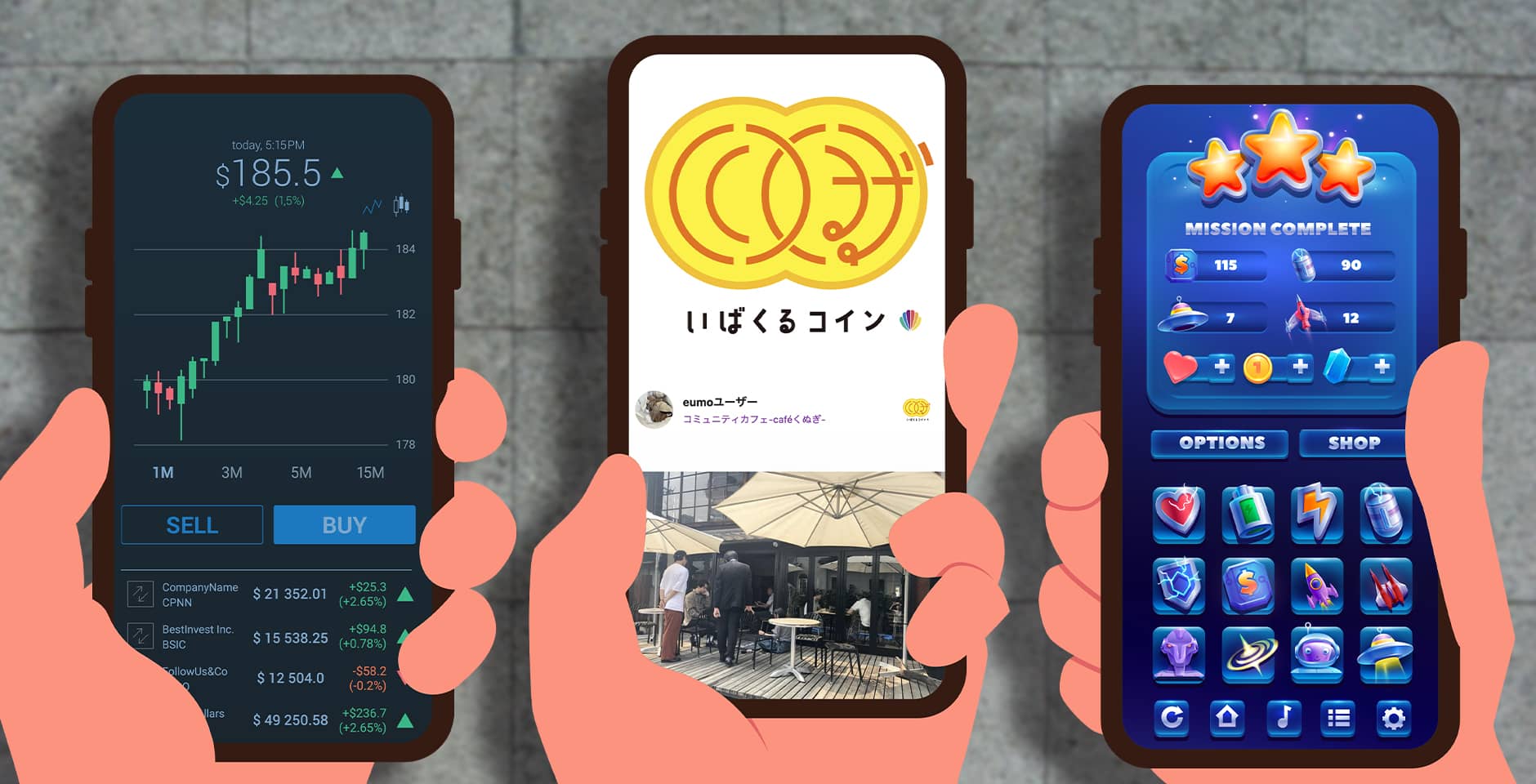
Mori’s work is not limited to research. He is also engaged in practical efforts to create new kinds of economic behavior. One such initiative is Ibakuru Coin, a community currency that he is involved in operating.
Ibakuru Coin is a local currency intended for circulation in Ibaraki City, Osaka Prefecture, where Ritsumeikan University’s Osaka Ibaraki Campus is located. Its name reflects the idea of the currency circulating throughout (“kurukuru mawaru”) Ibaraki, connecting people. The project is jointly managed by faculty members and students from Ritsumeikan University and local merchants in Ibaraki City.
So far, since launching the Community Currency Project, the members have explored mechanisms for issuing Ibakuru Coin and ensuring its circulation within the community. “One of our aims is to use Ibakuru Coin as a form of compensation for volunteer and community activities, thereby revitalizing community cooperation initiatives and strengthening connections among the residents. At the same time, we hope that having people spend Ibakuru Coin at participating shops will also help stimulate the local economy. That’s the kind of system we would like to create,” Mori says. Expectations are now high to see what role Ibakuru Coin will play in the community going forward.