


Outline of collaborative research
According to the Ministry of Foreign Affairs of Japan, nearly 5 million Japanese and their descendants live overseas, mainly in the Americas. This is the result of an international migration process that started in the 19th century, looking for a better future, and it has evolved into the formation of Nikkei (Japanese descent) communities around the world. Later, during the 1990s, a similar immigration process brought back several of these Nikkei to Japan.
Since the adaptation of these diasporic communities to different countries can give us insights into how to promote peaceful coexistence and integration of immigrant populations in present-day societies, this collaborative research examines their adaptation strategies in Japan and Peru. By comparing their migration processes through a multidisciplinary perspective ―arts, archaeology, anthropology, architecture, history, heritage studies, gastronomy, and literature― this research aims to understand how diasporic identities transform over time, guided by the following questions: What causes immigrant populations to change their social identity? When do these changes occur at the individual and collective levels? What cultural traits emerge during this transformation? The central hypothesis is that immigrants adapt by incorporating elements of the host culture, shaping their cultural identity in relation to the journey of the first immigrants rather than to the country of origin. At the same time, the host societies integrate immigrant cultures after several generations, enriching their own culture without losing their main identity.
Symposia, seminars, etc.
International convention
- International Joint Symposium “Interdisciplinary Perspectives on Peruvian Migration to Japan”, September 7, 2025, venue: OIC-Ritsumeikan University (Osaka, Japan), Organized by the Research Center for Pan-Pacific Civilizations, the Riva-Aguero Institute-PUCP.
- International Joint Symposium “Nuevas perspectivas sobre la diáspora nikkei”, August 22, 2024, venue: OPEN PUCP - Pontificia Universidad Católica del Perú, Organized by the Research Center for Pan-Pacific Civilizations, the Riva-Aguero Institute-PUCP.
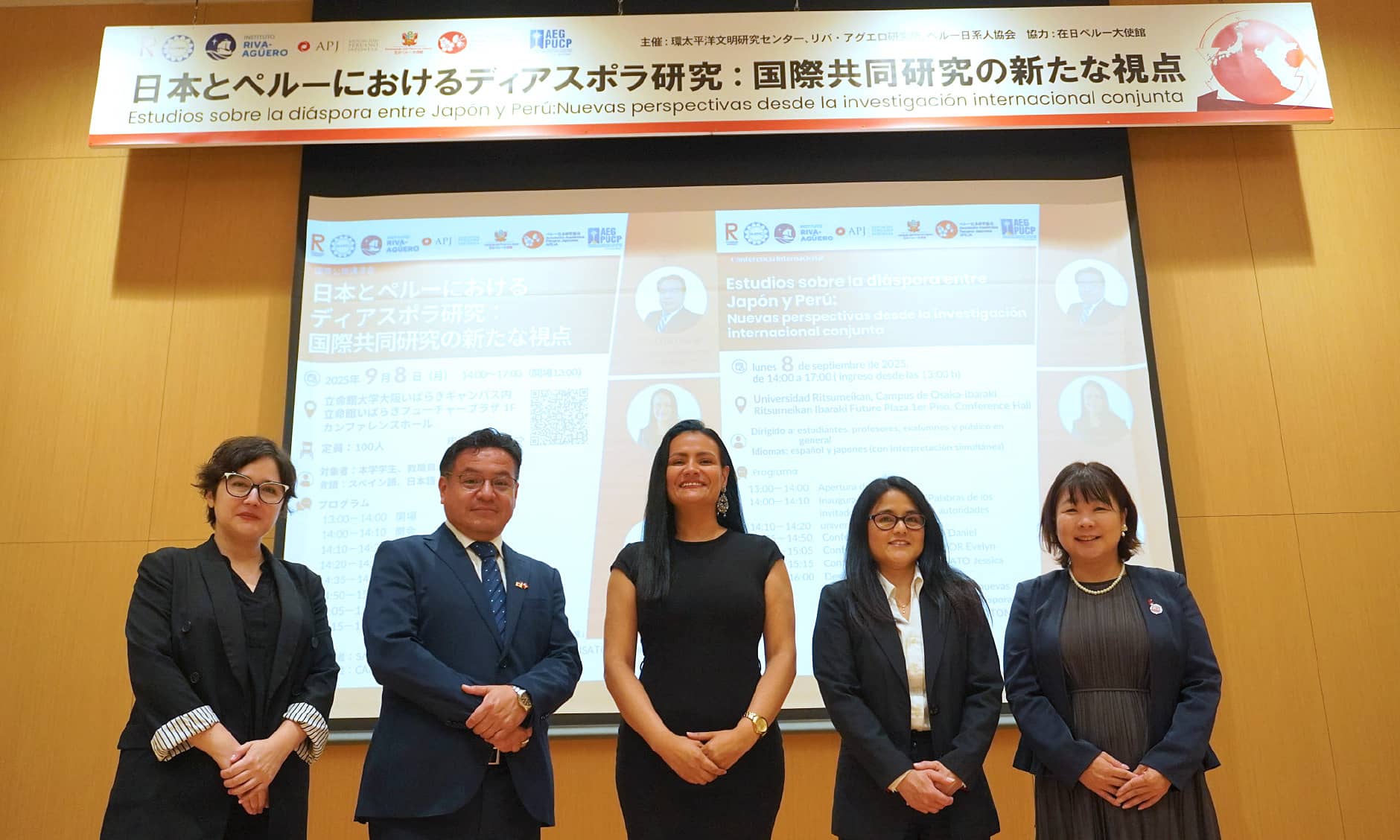
- International Public Conference “Studies on the Diaspora between Japan and Peru: New Perspectives from International Research”, September 8, 2025, venue: OIC-Ritsumeikan University, Organized by the Research Center for Pan-Pacific Civilizations, the Riva-Aguero Institute-PUCP and the Peruvian Japanese Association with the support of the Peruvian Embassy in Japan.
- Panel: Nuevas perspectivas para un estudio comparativo de la diáspora y el transnacionalismo entre Perú y Japón. May 25, 2024, venue: Keio University, Carried out at the Japan Association for Latin American Studies 45th Annual Congress.
Future prospects/aspiration
Unlike previous single-discipline studies, this research brought together Japanese and Peruvian researchers (including students) across diverse fields to share data, compare findings, and publish the results in multiple languages. Such a comparative approach in illuminating the dynamics of social and cultural change in both countries proposed new directions for future diaspora research, while also fostering a new generation of young researchers. In the future, this research aims to expand its scope to other Nikkei communities around the world, especially in Argentina, Brazil, Canada, and Chile, using the networks of current members to have a broader image of the formation of Nikkei identity and analyze adaptation strategies in different contexts.