


In commemoration of RADIANT's 10th anniversary, we have launched a feature showcasing interviews with international researchers, in the hope that it helps prospective international researchers envision life at Ritsumeikan University.
The Journey to Ritsumeikan
RADIANT, R hereinafter: Could you introduce yourself and tell us a bit about your current role at Ritsumeikan University?
Dr. Prabath Buddhika Kanduboda, Kanda hereinafter: My pleasure! My name is Prabath Buddhika Kanduboda, and I am currently an Associate Professor at Ritsumeikan International. I’ve actually been working at Ritsumeikan University since 2013, which means it’s been about 13 years now. I initially joined as a contract lecturer.
R: Thirteen years is a significant commitment! Could you walk us through your career path leading up to Ritsumeikan? We understand your initial dream wasn’t necessarily academia.
Kanda: That’s certainly true! My path has been quite unlikely, even to me. After finishing my master’s and Ph.D. degrees at Nagoya University, I held positions as a part-time lecturer at both Nagoya University and Aichi Toho University before coming here to Ritsumeikan University.
But if we go way back, my journey in Japan began when I first arrived for an undergraduate course at APU (Ritsumeikan Asia Pacific University). Honestly, I never thought I’d still be living in Japan a quarter of a century later, let alone working as an academic! My high school self was, at best, a mediocre student, and my big dream back then was to become a soldier like my father and travel to various countries around the world on adventures. What marked the start of this winding path was the discovery that I could potentially become a higher-ranking soldier if I held a university degree. My father, who had previously lived in Japan, encouraged this improbable journey.
R: That’s a wonderful twist of fate! Was the transition to academic life in Japan smooth for you?
Kanda: Not entirely smooth at the start. I found the initial adjustment at APU tough—it was my first time away from home, and I struggled academically and socially. However, something truly clicked in my second year at APU thanks to a teacher I met, and that sparked my serious interest in studies. Subsequently, I made a promise to my mother that I would obtain a Ph.D., even though, and this is funny, I had no idea at the time what a Ph.D. actually was, nor how long it would take to get one! (lol). At the point I obtained my Bachelor’s degree at APU, my dream of becoming a soldier had faded.
R: What ultimately drew you specifically to Ritsumeikan University for your academic post?
Kanda: The job content, for sure. The Global Gateway Program (GGP), a long-term study abroad initiative that combines language training and meaningful interaction with fellow students, was truly captivating. I suppose the fact that I had previously been at APU, and was therefore already familiar with the Ritsumeikan system, was also a contributing factor.
R: As an international researcher, did you face any unique challenges when you first settled in at Ritsumeikan University?
Kanda: Compared to many others, my transition was probably much smoother. I had already been in Japan for over a decade when I took the post here, so I was quite familiar with the language and the general way things are handled in the country. Especially, having already endured considerable hardship through the path to earning my Ph.D., I did not find the transition to my appointment at Ritsumeikan particularly difficult.
There is one area, though, where improvement could be made at Ritsumeikan University, particularly for incoming international scholars. The initial support upon arrival was almost nonexistent—though perhaps I didn’t notice because I didn’t actively seek it out. More critically, the subsequent support available for fixed-term contract and part-time researchers in securing essential research funding, such as individual research allowances or KAKENHI, was a little feeble. Strengthening this kind of support would definitely boost Ritsumeikan University’s reputation among international researchers looking for opportunities here.
Research & Teaching
R: Now, let’s dive into your work. Could you briefly explain your primary research field?
Kanda: My core research focuses on sentence processing within Sinhala, Japanese, and English languages, viewed through the lenses of applied linguistics and psycholinguistics.
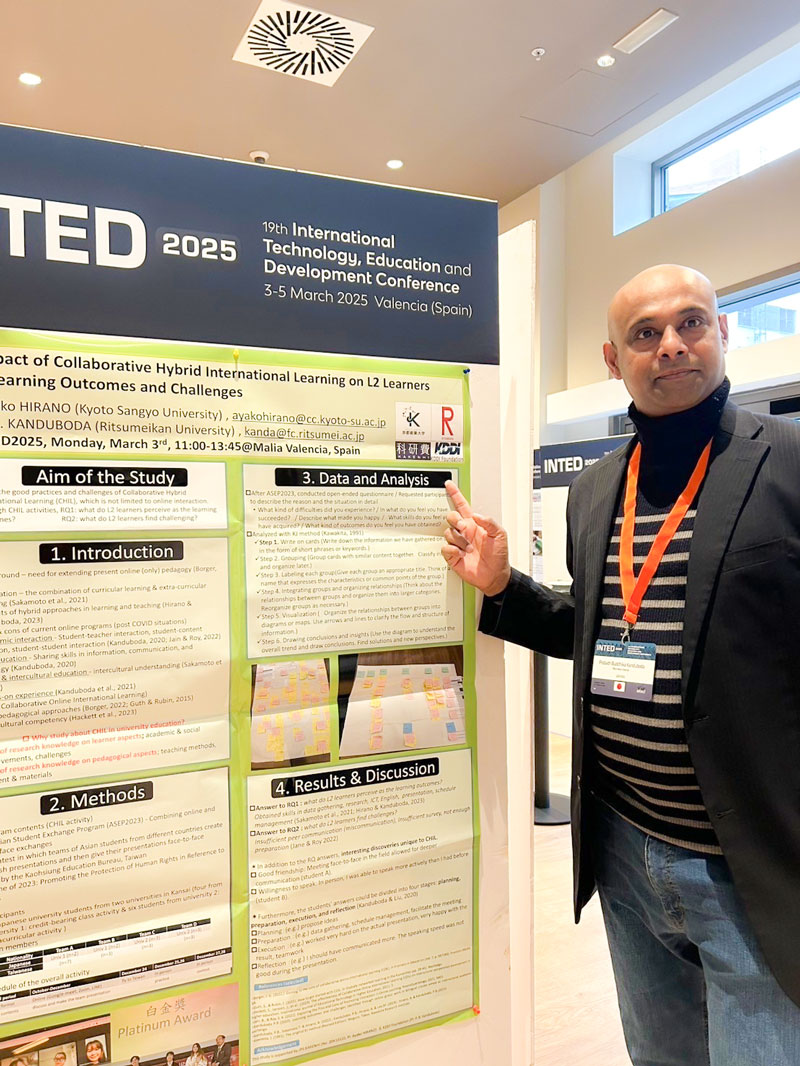
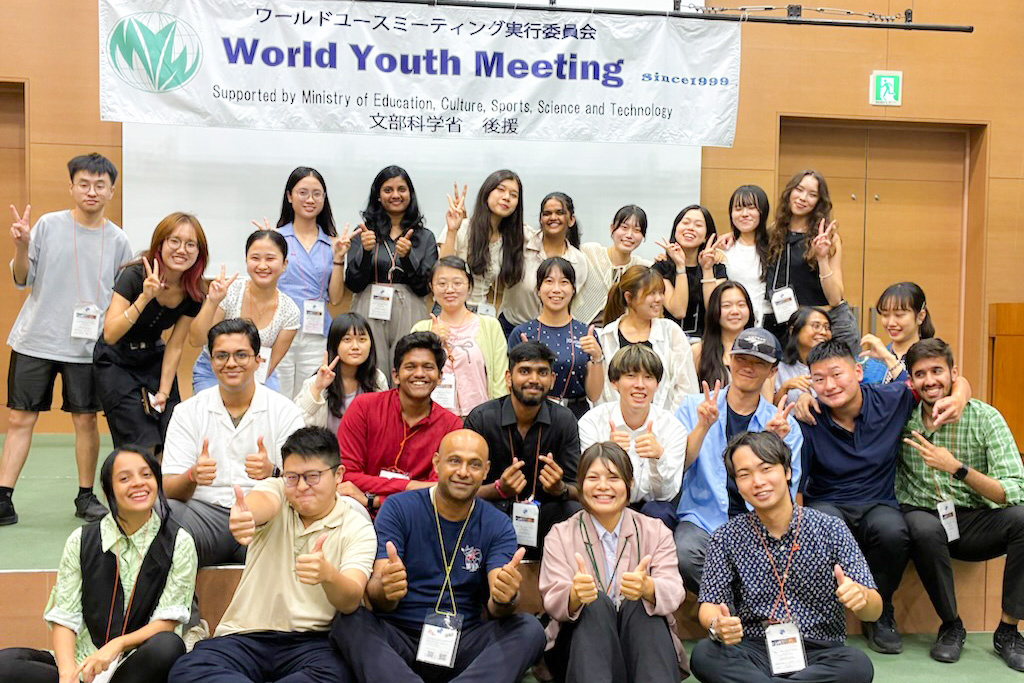
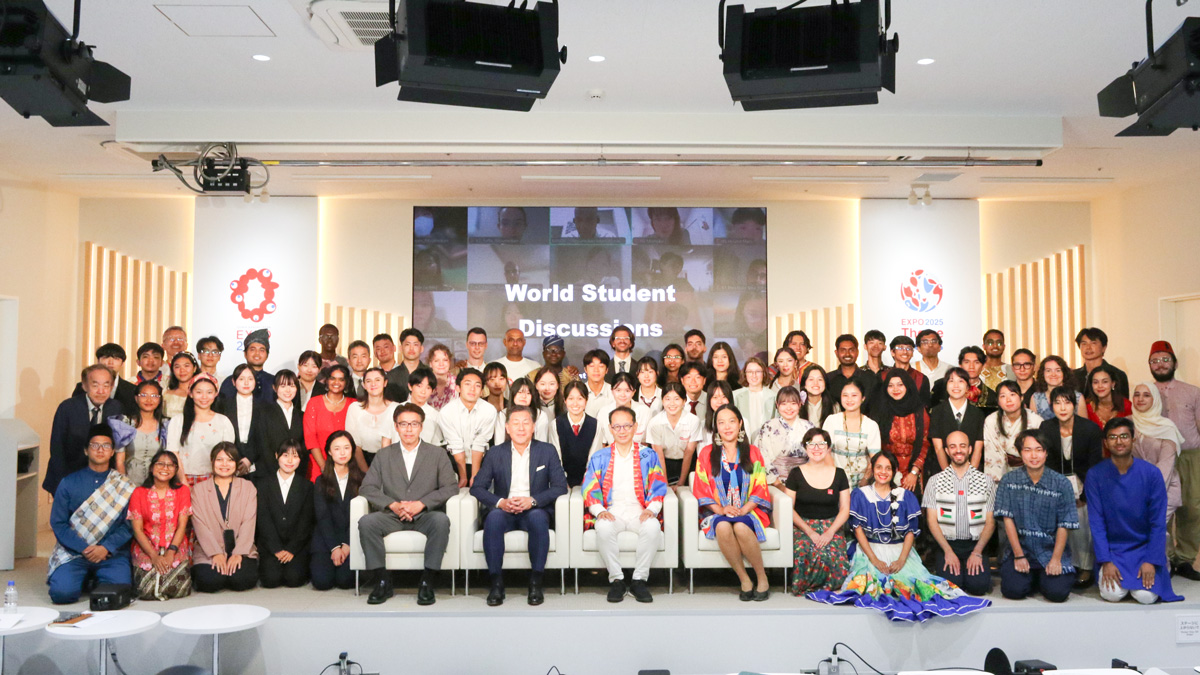
Kanda: Beyond that, I also engage in other projects. This includes research related to fostering CHIL (Collaborative Hybrid International Learning), analyzing self-accessed learning center activities, and studying abroad programs as they relate to university students. I find that talking with international students is often fundamental to my work because it frequently induces fresh perspectives, which I truly enjoy.
R: How would you rate the research environment at Ritsumeikan University generally, based on facilities, organization, and support?
Kanda: I’m happy to share my ratings. I’d score the facilities at 8/10 and the support programs also at 8/10. However, I’d rate the organizations slightly lower at 6/10.
If we specifically look at support toward writing proposals for JSPS (Japan Society for the Promotion of Science) and applying for external grants, I think that score jumps up to 9/10—the dedicated help there is excellent. Sometimes I feel the Division of Research staff know more about my research than I do!
That said, I have to mention one system that currently perplexes me: the recent introduction of the Research Budget Management System (Budget Cycle Management, or BCM). I find it quite difficult to get used to.
Life Outside the Work
R: Switching gears to life outside the work, where do you currently reside, and what is the area like?
Kanda: I live in Kyoto, specifically in Kita Ward. It’s a lovely area situated close to some beautiful historic sites like Kenkun Shrine, Daitoku-ji Temple, and Kinkaku-ji. It’s a very nice neighborhood in general, offering good proximity to shopping and everything needed for comfortable living.
R: How do you typically spend your days off?
Kanda: My days off usually revolve around my family. I really enjoy hanging out with them. We also love to host, quite frequently, I’m barbecuing at home with friends. Occasionally, we take a trip to visit my former host family in Beppu, Oita Prefecture.
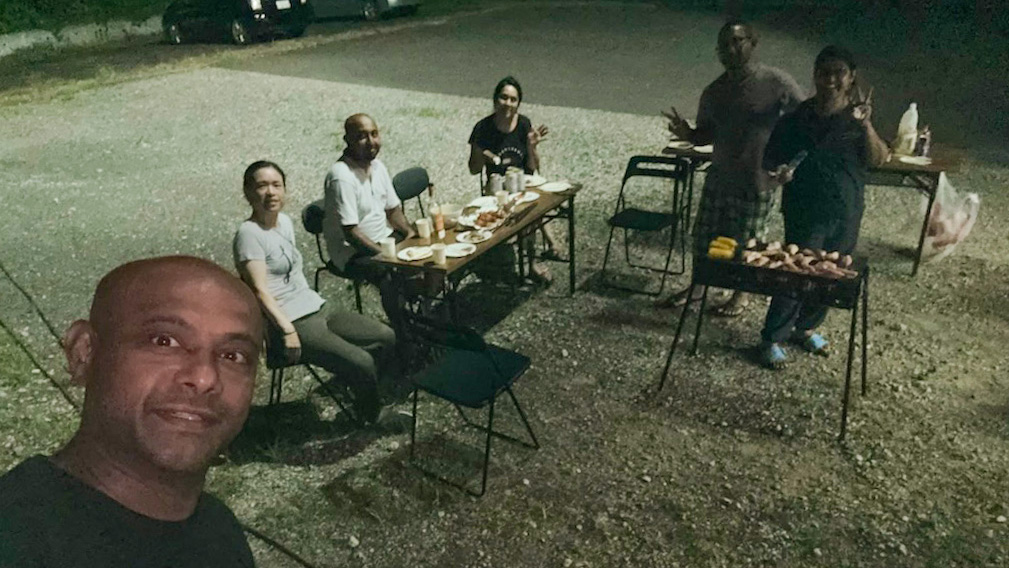
Kanda: I also enjoy engaging in some sports. I suppose that inclination stems from my initial dream of becoming a soldier—that competitive spirit remains!
R: Do you have any favorite local spots in Kyoto that you and your family visit regularly?
Kanda: Not super regularly, perhaps, but two places we enjoy are the bankside of the Kamo River and the Kyoto City Zoo. They’re both great places for a relaxed outing.
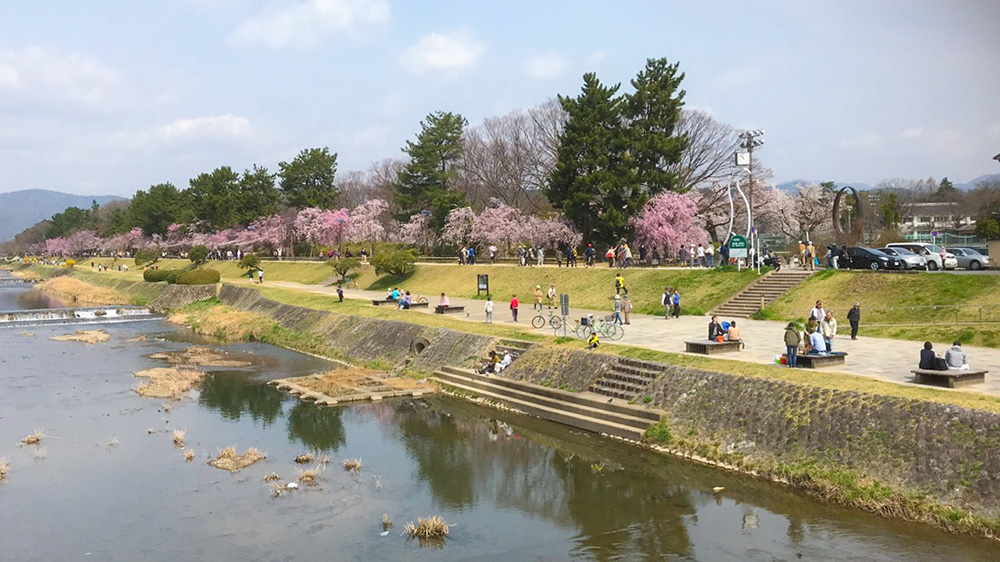
R: Do you interact socially with colleagues at Ritsumeikan University outside of professional meetings?
Kanda: Yes, definitely, I have a few colleagues I regularly interact with socially. Among them, some are Ritsumeikan University faculty and administrative staff, research colleagues, APU and Nagoya University alumni members, people from the Sri Lankan community, etc.
Looking Ahead
R: Finally, looking ahead, what is your future outlook for research at Ritsumeikan?
Kanda: Having achieved tenured faculty status in April 2023, I have a clear path forward. I am focused on several key areas: I want to enhance my present research approach and extend some of my skills to develop a better research-focused course for students. And of course, the goal is always to publish more papers, hopefully in high-impact journals. It’s about building on the foundation I’ve established here over the past decade.