


Ritsumeikan University has launched an initiative to establish a new research field known as Body Sphere Research. A defining feature of this field is its focus on understanding the internal and external aspects of the human body in terms of their relationships. Professor Norihiro Sadato approaches this emerging field through the lens of neuroscience with the aim of contributing to the realization of well-being.
The history of interactions between the body and the environment is encoded in the brain
In 2024, Ritsumeikan University launched a new initiative to develop the field of Body Sphere Research.
With the advancement of Society 5.0, a world in which physical (real) and virtual (cyber) environments are increasingly integrated is beginning to take shape. In this kind of world, how do interactions between the body and different environments affect the human mind and body, and how do they contribute to the realization of well-being, including health and quality of life? Many researchers are exploring this question using an interdisciplinary approach that brings together multiple fields of study, and Sadato contributes to this effort from the field of neuroscience.
Sadato defines the “body sphere” as “embodied environment,” an extension of the concept of embodied cognition—namely, the interaction between the body and its social, physical, and internal environments. “As Homo sapiens, we have a history of more than 200,000 years of extending our bodies through the use of tools, dating back to the hunter-gatherer era. From an external perspective, this can also be understood as a history of the ‘embodiment of the environment.’ One of the central themes of Body Sphere Research is how to adapt bodies, which have been shaped through long-term interaction with the environment, to multiple, layered environments such as the metaverse,” he explains.
According to Sadato, a key feature of this new field is its focus not on the internal or external aspects of the human being, but on seeking to understand the relationships between the body and these aspects. How to understand the relationships between humans and the world has long been a subject of philosophical inquiry, and Sadato seeks to address this question from a scientific perspective.
So, what role can neuroscience play in studying these relationships centered on the body? “Humans are organisms that can exist only in relation to their environment. Cognition itself arises from the history of activity linked to the agent’s (subject’s) sensorimotor processes. This history, in other words, our memory, is prominently encoded in the brain, and the role of neuroscience is to measure and elucidate these processes,” explains Sadato.
To provide one piece of evidence for this, Sadato uses experimental methods to elucidate how individuals generate subjective cognition through interactions with their environment. Sadato and his colleagues conducted MRI scans of visually impaired individuals, analyzing neural activity through blood flow measurements. They observed that when subjects read Braille, neural activity in the primary visual cortex, which normally processes visual information, became more active. This suggests that the primary visual cortex is processing tactile information from the fingertips. The loss of visual input leads to dramatic neuroplasticity, demonstrating how a new form of cognition— that is, a new way of perceiving the world—can emerge within the tactile environment,” he notes.
The crucial role of emotions in the relationships between the body and its internal and external environments
Next, Sadato highlights embodied cognition as a key concept for understanding the series of relationships between the body and its internal and external environments, which constitute the body sphere. “J.J. Gibson, a pioneer in perceptual psychology, challenged the classical Cartesian model, which treats the body, the world, perception, and action as separate entities. Instead, he proposed that the process of perception is the product of an active agent and its relationship with a specific environment. Simply put, action is essential for perception, and cognition and action cannot be separated; they operate using the same model,” he explains.
Previous studies have demonstrated this idea from a neuroscientific perspective. In experiments with monkeys, it has been shown that the same region of the frontal lobe is activated both when performing an action (such as grasping an object) and when observing another individual perform the same action.
Building on this argument, Sadato suggests that if the same neural circuits are involved in both recognizing others’ actions and expressing one’s own actions, then both of those actions should begin to resemble each other. This phenomenon is known as synchronization. According to Sadato, synchronization has long been observed between individuals and has also been confirmed at the level of neural activity. “What is particularly interesting is that the emotion of happiness arises through these interactions between the self and others,” he notes. Previous studies have shown that when two individuals imitate one another, the person being imitated experiences positive emotions, which in turn prompts them to prosocial behavior. “Being imitated can be seen as a ‘reward’ triggered by others’ reactions to one’s own actions (or social contingency). This highlights not only the importance of reciprocal imitation in social environments, but also the vital role of emotion within the structure of the body sphere,” he explains.
Measuring neural activity in the brain to uncover the mechanisms underlying the enhancement of well-being
The body sphere is also closely linked to human well-being through emotions. This is why the Body Sphere Research project has set the realization of well-being as its objective.
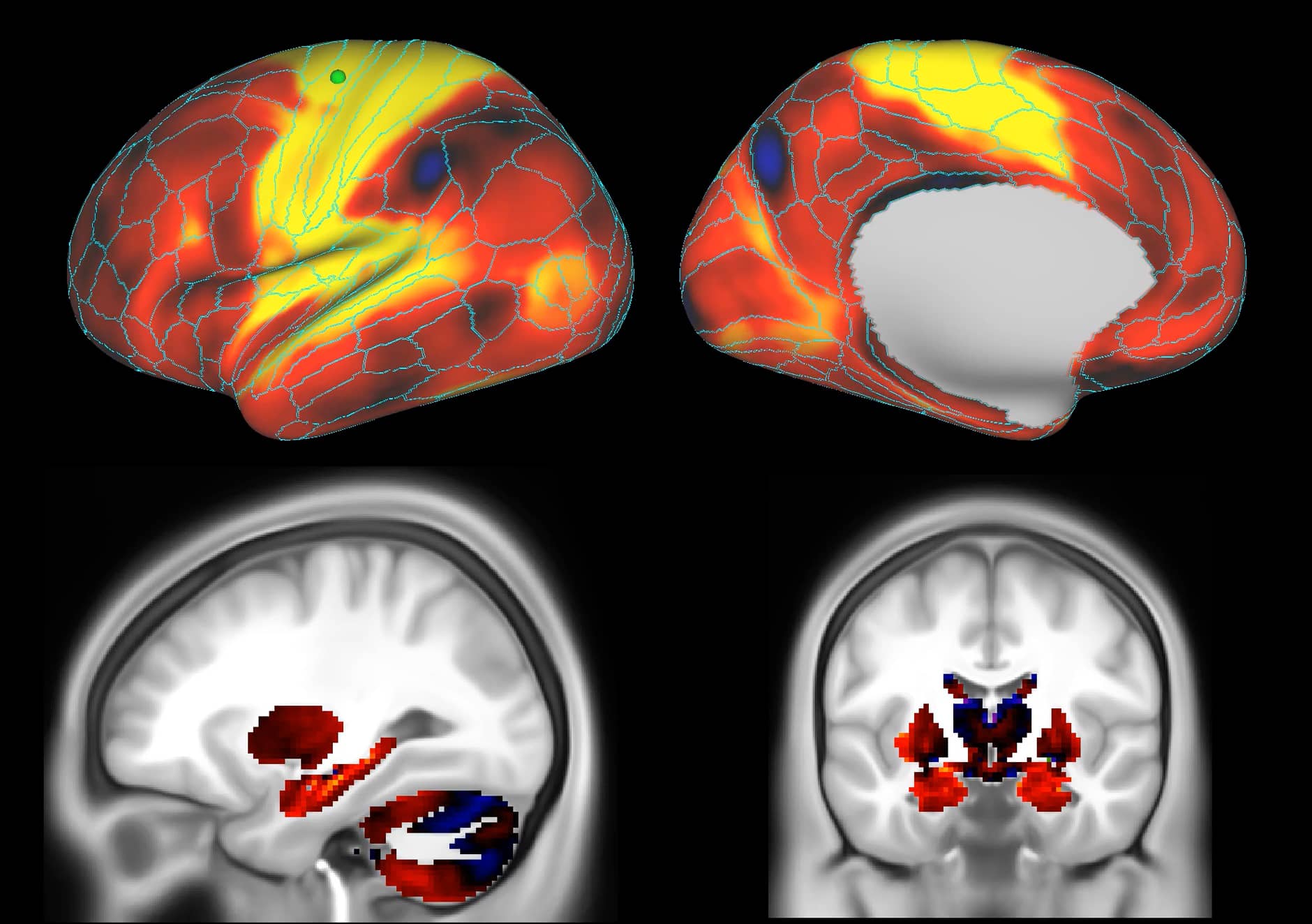
Sadato focuses in particular on social recognition as one of the fundamental components of well-being. “Its origin lies in the mother-infant relationship, where the infant maintains its own homeostasis through another person (the mother),” he notes. Humans cannot survive as isolated individuals. Relationships with the outside world are essential for maintaining homeostasis. This, in essence, is the significance of communication. Using functional magnetic resonance imaging (fMRI), which enables simultaneous measurement of brain-wide activity, Sadato is studying neural activity during interpersonal communication in order to uncover the mechanisms through which well-being is enhanced through communication.
Another point is that well-being is often translated as “happiness” in Japanese. “There are two aspects to this: a perceptual aspect and a behavioral aspect—or, to put it simply, ‘pleasure’ and ‘fulfillment.’” According to Sadato, the latter is characterized by intrinsic motivation, that is, the desire to engage in an activity for its own sake. He is also working to elucidate the origins of this intrinsic motivation at the level of neural activity.
What, then, is essential for living a life full of well-being? By focusing on the body sphere—that is, relationships—Sadato intends to continue exploring this question.