

In recent years, as large-scale natural disasters have become a frequent occurrence, the importance of mutual aid among residents during emergencies has been increasing. Dr. Yusuke Toyoda studies disaster preparedness activities and policies aimed at strengthening community-based disaster resilience, which serves as the foundation for mutual aid. By organizing disaster preparedness events that incorporate games, he approaches the enhancement of local disaster resilience from both academic and practical perspectives.
Exploring how to engage reluctant working-age residents in local disaster management activities
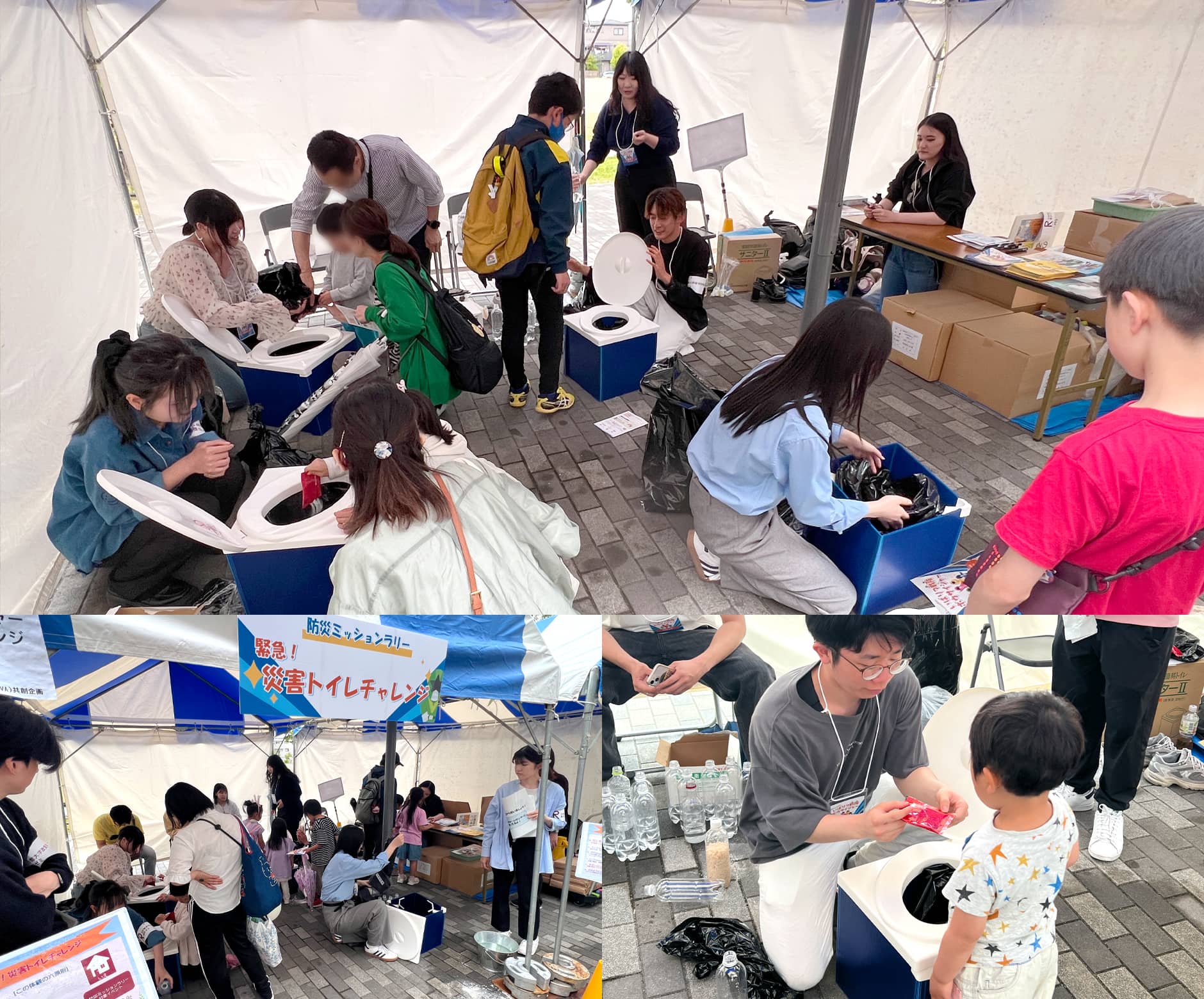
On May 19, 2024, Ibaraki x Ritsumeikan Day 2024 was held as a joint community exchange event between Ritsumeikan University and Ibaraki City, Osaka Prefecture. One of the featured activities was a disaster preparedness event called “Emergency Toilet Challenge,” which was conducted as part of the “Disaster Management Mission Rally” Team Expo 2025 Co-Creation Challenge. The event simulated a situation in which household toilets became unusable after an earthquake, having participants experience how to use an emergency toilet. Approximately 300 children took part, and explanatory materials were distributed to their parents observing nearby.
This initiative was jointly planned and implemented by Toyoda and students from his seminar, in collaboration with the Crisis Management Office of the Ibaraki City General Affairs Division. “When disasters occur, the importance of mutual aid among residents is often emphasized, and there is increasing demand for bottom-up, community-led disaster preparedness. However, in reality, participation in local disaster management activities tends to be led by older adults, and one issue we face is the weakening ties between working-age residents and their communities. How can we encourage people who are reluctant to participate in these kinds of local disaster management activities to get involved? This event also served as a pilot study aimed at addressing this issue,” Toyoda explains.
Toyoda has been conducting academic research on participation in local disaster management activities and the awareness-raising effects of such activities. Drawing on a web-based survey conducted in August 2017, he analyzed responses from 610 individuals aged 18 to 49 regarding their attitudes toward local disaster management activities. Participants were asked which types of activities they would be willing to join, choosing from eight options including disaster drills, disaster-themed sports festivals, disaster preparedness events, and combinations thereof, as well as the choice of “none of the above.” The results showed that while the largest proportion (30.2%) selected “none of the above,” the second most common response (19.8%) was “disaster preparedness events only.” Other top responses included “disaster drills only” (15.2%) and “a combination of disaster drills and disaster preparedness events” (14.3%). These findings indicate that disaster preparedness events could play a key role in encouraging participation in local disaster management activities.
Further analysis revealed that those with higher levels of disaster awareness and preparedness tended to prefer drills, while those with moderate levels were more likely to choose disaster preparedness events. Meanwhile, those who engage in fewer disaster preparedness activities tend to prefer initiatives with less emphasis on disaster drills. Of particular interest to Toyoda was the finding that men and households with elementary school-aged children or younger were more likely to prefer programs that included disaster preparedness events. “These results suggest that to engage working-age residents, where we face the issue of low participation, and those with lower levels of disaster preparedness, it is effective to offer programs centered on local disaster preparedness events, or combinations of drills and events,” he notes.
Running disaster preparedness games designed by students
Conducting empirical research through community-based events
Toyoda’s work goes beyond academic research. He runs local disaster preparedness events and evaluates their effectiveness. In particular, he focuses on incorporating games into these activities, citing the following reason: “Experience-based, action-oriented learning is more likely to succeed than classroom-based instruction using textbooks.” He also highlights key elements of disaster preparedness games, stating, “They should guide participants to discover their own solutions and strengths, convey information about their local communities and what they can do themselves, and provide opportunities for parents and children to learn together.”
Another key element is student participation based on the theory of legitimate peripheral participation. According to Toyoda, this theory views learning as a process of increasing one’s degree of participation in a community of practice. Individuals initially participate from the periphery as novices and then gradually become full (or legitimate) members as they gain expertise over time. For learners, it is a process of growth, but participation from the periphery can also benefit the community of practice. “Because they are not bound by conventions or specialized knowledge, novices can inject fresh ideas with a flexible mindset. That is where I hope students can contribute,” Toyoda explains.
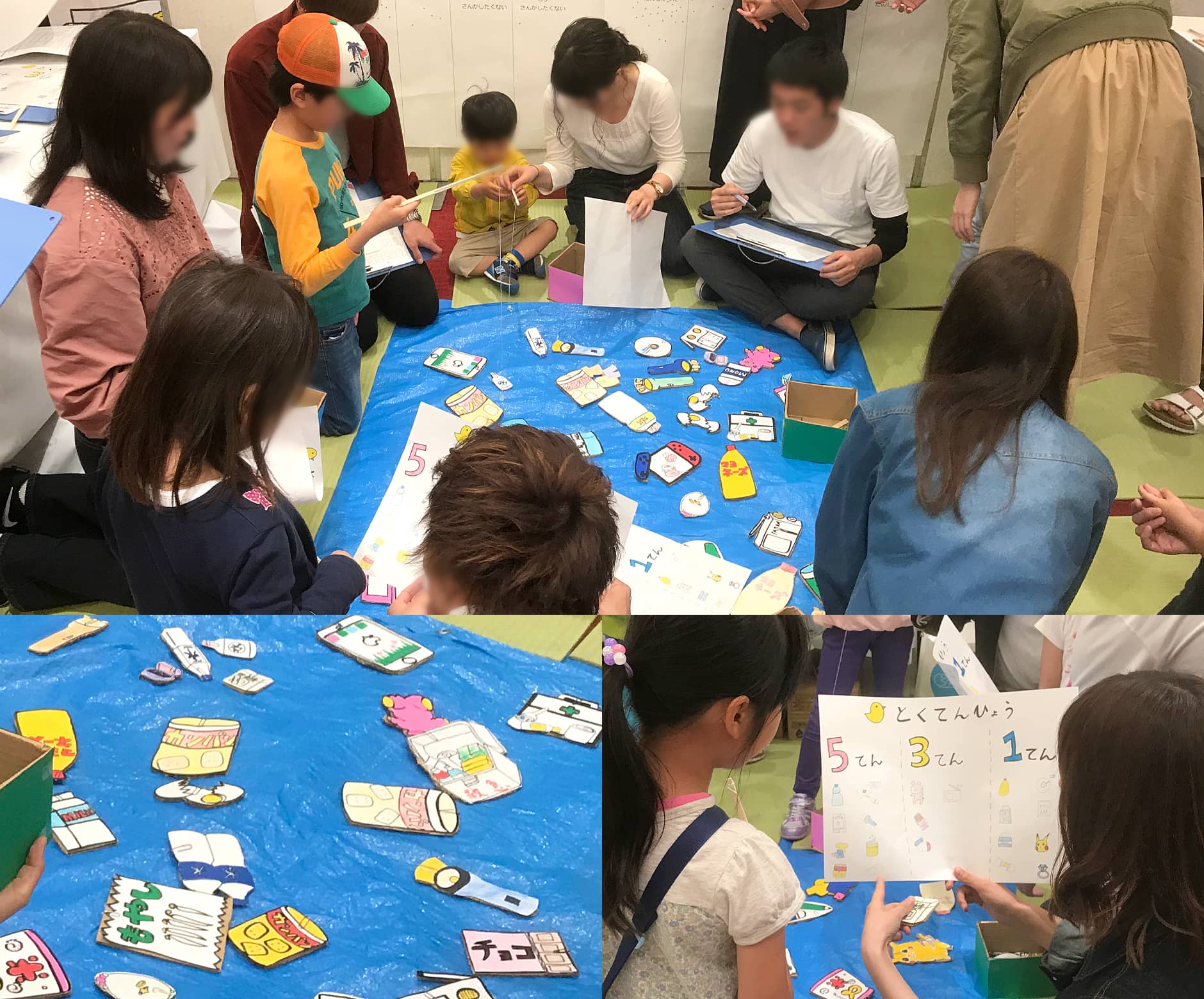
At Ibaraki x Ritsumeikan Day 2018, Toyoda’s students designed and implemented a “Disaster Preparedness Goods Fishing Game.” In this game, players “fish” for essential emergency supplies from a deck of cards featuring various items; the points awarded for each catch vary depending on how essential the item is. It is designed to help participants experience disaster preparedness in a hands-on manner by thinking about what items are needed in an emergency and then "catching" them to place in a container (emergency kit). “After the first round of the game, we explained its purpose and the meaning of each item, then had the children try again. Most of them achieved higher scores the second time. This suggests that even in the short term, the game increased disaster awareness and the ability to prepare,” Toyoda notes. Toyoda also conducted a survey with their parents observing the event, which revealed that, while it goes without saying that those who regularly participate in disaster drills were enthusiastic about them, roughly half of those who had never or rarely participated in them expressed a desire to participate in the future. The game has since expanded beyond the confines of Toyoda’s seminar, having been adopted in regional disaster drills involving Osaka Prefecture.
“The next challenge is how to translate this increased awareness and motivation into actual participation in local disaster management activities such as drills,” Toyoda says. He continues to explore this issue in collaboration with local communities and government agencies. In addition, Toyoda is supervising the “Disaster Management: Uniting for a Safer Tomorrow" exhibition to be presented by Seiryo Electric Corporation at Expo 2025 (Osaka, Kansai, Japan) as part of the “Future Life Experience” program. Through collaborations like this, he aims to further strengthen local disaster resilience.