


In recent years, many universities have introduced community-based learning programs such as service learning. Does this kind of learning benefit not only the students but also the communities that host them? Through her teaching practice in class, Professor Megumi Akiyoshi explores the potential for university education to contribute to the well-being of local residents.
What does university service learning bring to local communities?
Service learning integrates volunteer and social contribution activities in local communities with academic learning, connecting practical experience with the resolution of social issues. In Japan, it has increasingly been incorporated into educational programs at both universities and high schools. Akiyoshi asks: “What benefit do these forms of community-based learning actually bring to the communities that host the programs?”
Her research focuses on the processes through which people in local communities proactively achieve well-being. She has previously examined the impact of community development initiatives led by NGOs and NPOs in rural areas across Japan and Asia. In recent years, she has expanded her focus to include service learning in higher education as a form of community engagement. One example is her research based on the teaching practices she employs in the “Citizenship Studies” course she teaches at Ritsumeikan University.
Changes in the relationships between students and community members
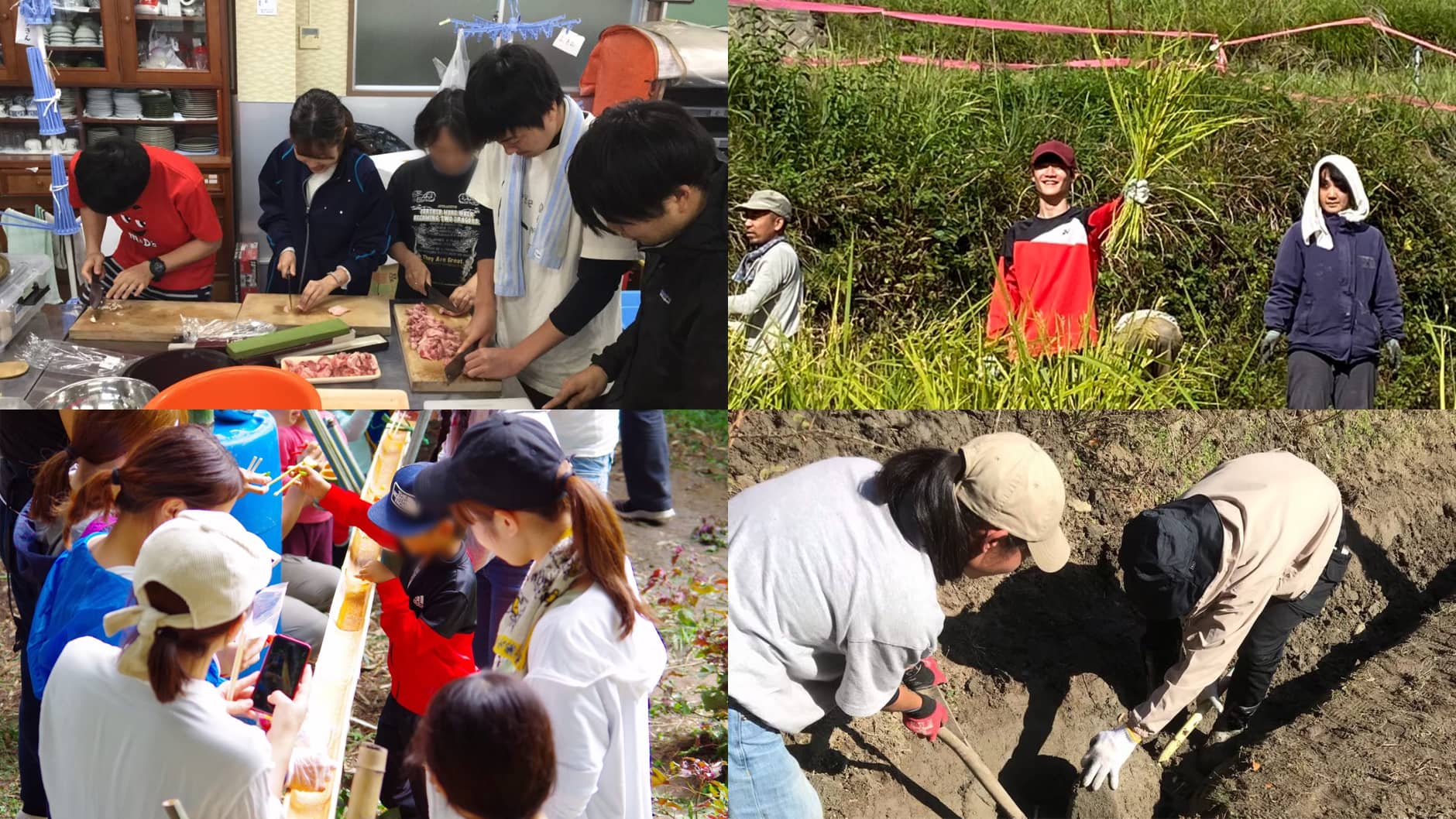
“Citizenship Studies” is a liberal arts course at Ritsumeikan University in which students collaborate with NPOs, NGOs, civic organizations, and government agencies. By working alongside residents to help resolve social issues that are close to home, students develop a sense of citizenship. As part of this program, Akiyoshi has implemented service learning since AY2015 in collaboration with the Hokuchi Community Council in northern Ibaraki City, Osaka Prefecture. The Council promotes initiatives aimed at preserving ways of life in harmony with nature and passing on the region’s original landscapes to future generations. Based on project plans proposed by the Council, students travel to the area to engage in activities such as assisting with agricultural work, clearing abandoned farmland, and helping with satoyama management and the maintenance of traditional houses.
Akiyoshi focuses on how relationships between students and community members evolve through these activities. “At first, residents would address them simply as ‘the students,’ treating them as a homogeneous group. Over time, however, they began to call them by name. Eventually, relationships developed into ones of trust where residents realized they could rely on certain students for certain tasks, and the students felt they had to try harder because of the trust put into them. Through these interactions, people grow closer, and attitudes such as sincerity and fairness begin to shape the relationships. What starts as a relationship between those assigning tasks and those carrying them out evolves in the end into one in which both sides trust each other and work together to resolve local issues,” she explains.
The “fluctuations” in seesawing relationships that drive growth on both sides
Akiyoshi also highlights that relationships do not always progress in a linear, positive direction. Rather, they often involve a dynamic process of advancement and regression—what she describes as “fluctuation.” “In AY2018, the northern area was struck by two major disasters, an earthquake and flooding caused by a typhoon, and as a result, the Hokuchi Community Council proposed changing the topic midway through the program. For local farmers affected by the disasters, shifting toward a more sustainable way of living was a natural response. However, some students who were not fully aware of the extent of the damage to the area questioned the sudden change after having made preparations based on the original topic,” she explains. Both Council members and students differ in their levels of familiarity, sincerity, and sense of fairness, resulting in diverse and sometimes uneven relationships. Akiyoshi analyzes that as changes in these relationships accumulate, they produce a pattern of fluctuation characterized by repeated advancement and regression.
“What is particularly noteworthy is that such fluctuations in relationships can lead to greater growth than when relationships develop smoothly,” she notes. Through these processes, where once-positive relationships temporarily regress and then move forward again, most students showed changes in their attitudes both in the classroom and in the community, as well as their engagement with local issues. At the same time, local residents also changed their attitudes, using dialogue with students as an opportunity to articulate their own perspectives. “These fluctuations not only foster growth in students’ learning attitudes, interpersonal skills, and sense of responsible citizenship, but also influence the attitudes and values of community members, enhancing their ability to recognize and build trust,” Akiyoshi explains.
From these findings, Akiyoshi suggests that changes in individual skills, attitudes, and values that stem from the changes and fluctuations in the relationship between the university and community may contribute to the development of individual and social capital. Social capital is the idea of viewing relationships among people as a form of capital. In other words, student participation in community activities through service learning has the potential to become a beneficial form of capital for community development and the well-being of local residents.
Akiyoshi continues to conduct research that explores the processes through which university-level service learning fosters social capital. Can community-based university education truly create meaningful value for local communities? Her research offers an important contribution to this ongoing question.